Signs Your Brake Pads Need Replacement
Discover More On:
The signs your brake pads need replacement include persistent squealing, grinding, longer stops, a brake-wear warning, and visibly thin friction material. Some symptoms can also come from rotors, calipers, fluid, or hardware. At Parks Automotive, we inspect the full brake system so Cape Girardeau drivers know what is worn.
Why Brake Pads Wear Out
Brake pads are wear items. Their friction material presses against the rotors to slow the wheels, so a small amount is used every time the vehicle stops.
Friction Material Gets Thinner With Every Stop
Front pads often wear faster because the front axle handles more of the stopping load on many vehicles. Pad material, vehicle weight, rotor condition, and caliper movement all affect the wear rate. Our
brake pad replacement service includes thickness measurement and checks of the related hardware.
Driving Conditions Change Brake Pad Life
Frequent stops along Broadway, William Street, and Kingshighway create more brake heat than steady highway travel. Towing, heavy loads, and downhill braking can also shorten pad life. Mileage alone cannot determine replacement timing because vehicles with the same odometer reading may have different wear.
Signs Your Brake Pads Need Replacement
Worn brake pad symptoms should be evaluated together rather than treated as a diagnosis on their own. Noise, pedal feel, stopping response, and direct measurements provide a clearer picture.
Squealing or a Wear-Sensor Light
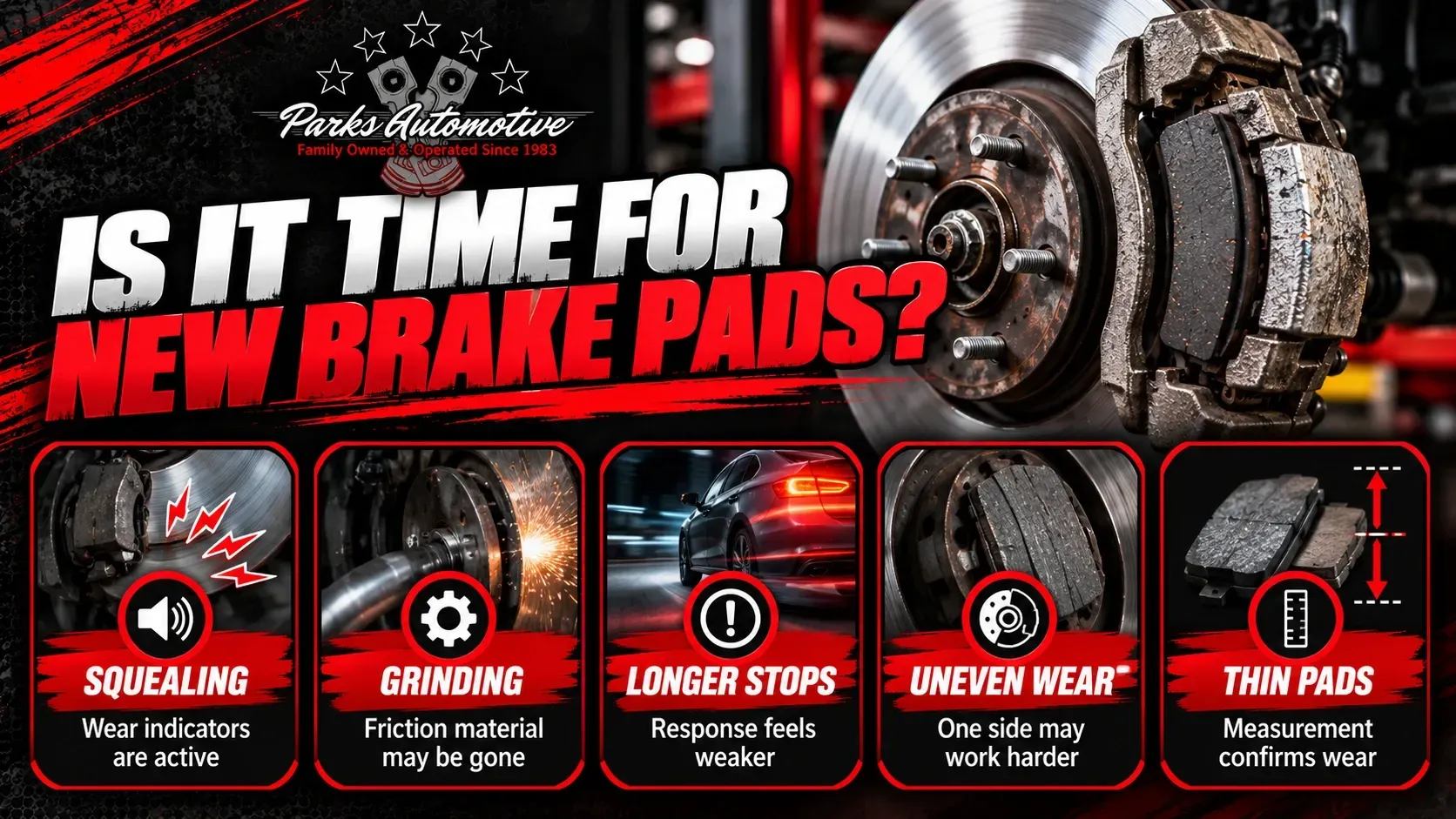
Many pads use a metal wear indicator that makes a high-pitched squeal as the friction material gets thin. Other vehicles use an electronic sensor that turns on a dashboard message. Persistent squeaking brakes call for an inspection, although moisture, dust, glazing, or loose hardware can also create noise.
Grinding or Scraping During Stops
Grinding may mean the friction material has worn away and the pad backing plate is contacting the rotor. Continued driving can score the rotor and reduce braking performance. If grinding is constant or stopping ability changes, limit driving and arrange an inspection rather than waiting for the next maintenance visit.
Longer Stopping Distance or Weak Response
A vehicle that needs more room to stop may have worn pads, overheated friction material, or another brake-system fault. This change can be easiest to notice when slowing from I-55 speeds or approaching traffic near the Bill Emerson Memorial Bridge. Because tires, road conditions, and hydraulic problems also affect stopping distance, the cause must be confirmed.
Uneven Wear, Pulling, or Excess Brake Dust
One pad can wear faster when a caliper piston or slide pin sticks. The vehicle may pull during braking, one wheel may feel unusually hot, or one wheel may collect more dust. Our brake repair and safety inspection evaluates pad wear together with the calipers, rotors, hoses, fluid, and ABS components.
Measured Pad Thickness Near the Limit
Direct measurement is the clearest way to judge remaining material. Pads at or below about 3 mm commonly need replacement, but the decision also depends on manufacturer specifications, wear pattern, and vehicle use. Missouri’s motor vehicle safety inspection guidance confirms that pads or linings, rotors or drums, and brake performance are part of the state inspection process.
Symptoms That May Point Beyond the Pads
Not every brake complaint is caused by thin pads. A complete inspection separates ordinary friction-material wear from rotor, hydraulic, caliper, and electronic faults.
Pulsation Usually Involves Rotor Condition
A pulsing pedal or steering-wheel vibration often points to rotor thickness variation or runout rather than pad wear alone. Uneven pad deposits, a sticking caliper, and wheel or suspension issues can create similar sensations. Rotor measurements help determine whether resurfacing or replacement is appropriate for that vehicle.
Soft Pedals and Warning Lights Need Full Diagnosis
A soft or sinking pedal can involve air, contaminated fluid, a leak, a master-cylinder fault, or caliper trouble. An ABS light points to an electronic or wheel-speed issue, while a red brake warning may indicate low fluid or another urgent concern. These are not symptoms to solve by installing pads without further testing.
What Happens During a Brake Pad Inspection
A brake inspection should document what is worn, what remains serviceable, and what caused any uneven wear. We use physical measurements and a road test before recommending parts.
Pad, Rotor, Caliper, and Hardware Checks
We measure pad thickness, inspect both sides of the rotor, check rotor runout when needed, and look for uneven wear. Caliper pistons, slide pins, boots, hoses, and hardware are checked for sticking, leaks, or damage. This measured process is part of the auto repair services we provide for domestic, Asian, and many European vehicles.
When Rotors or Sensors Need Attention
New pads need a suitable rotor surface to bed in and work evenly. Deep scoring, excess runout, heat damage, or minimum-thickness limits may make rotor replacement necessary. Some vehicles also require a new wear sensor or an electronic parking-brake service procedure. Our Ford repair service includes brake measurements and pad selection for cars, SUVs, and trucks, including vehicles used for towing.
Takeaways
Persistent squealing, grinding, longer stops, a wear-sensor light, and thin measured material can all indicate worn brake pads. Grinding may mean the backing plate is touching the rotor, which can deepen rotor damage with continued driving. Pulling, unequal brake dust, or a hot wheel may point to uneven pad wear from caliper trouble.
A pulsing pedal, soft pedal, or ABS warning can involve parts beyond the pads. Each of these symptoms calls for a full diagnosis. Pad thickness, rotor condition, caliper movement, and vehicle specifications should guide the replacement decision.
Frequently Asked Questions
How long do brake pads usually last?
Brake pad life varies widely with the vehicle, pad material, traffic, towing, terrain, and driving habits. Inspection and thickness measurement are more reliable than using one mileage interval for every vehicle.
Can I drive with squeaking brakes?
You may be able to drive briefly if the brakes still respond normally and the sound is a light squeal, but the vehicle should be inspected soon. Stop driving and arrange assistance if the noise becomes grinding or the pedal, stopping distance, or vehicle control changes.
Does grinding always mean the brake pads are worn out?
No, grinding does not always prove the pads are worn out. Metal-to-metal pad contact is a common cause, but rotor shields, debris, calipers, wheel bearings, and other parts can create similar sounds.
Do front and rear brake pads need replacement together?
No, front and rear brake pads do not always need replacement at the same time. Pads should generally be replaced in axle pairs, while each axle is evaluated separately for thickness, condition, and even wear.
How are brake pads measured during an inspection?
Brake pads are measured at the friction material, excluding the metal backing plate. A technician checks inner and outer pads because a sticking caliper can make one pad much thinner than the other.
Schedule Brake Pad Replacement With Parks Automotive
If you notice signs your brake pads need replacement, let our
Parks Automotive team measure the pads and inspect the surrounding brake components. For brake pad replacement in Cape Girardeau, MO, call
(573) 335-2599 or visit
17 S Park Ave, Cape Girardeau, MO 63703. We will explain the findings, provide a written estimate, and wait for your approval before repair work begins.

Bryant Parks
Bryant Parks is the owner of Parks Automotive LLC, a family-owned auto repair shop in Cape Girardeau, Missouri. He has worked full-time in the automotive trade since he was 16 and received his training at Nashville Auto Diesel College. In 2012, he took ownership of the shop his father, Joe Parks, founded in 1983.
Bryant and his daughter, Jessica Parks, lead a team that handles brake repair, engine diagnostics and repair, and suspension and steering repair. The shop services domestic, Asian, and European vehicles, including Ford, Chevrolet, Toyota, and Honda.
He traces drivability and electrical faults using a Snap-on Triton lab scope and a TOPDON Phoenix Max. These tools allow him to test sensors and circuits directly before recommending any part replacement.
More than four decades after his father opened the shop, Bryant continues to run it with the same approach. He explains what each vehicle needs in plain terms and treats every customer like family.
