
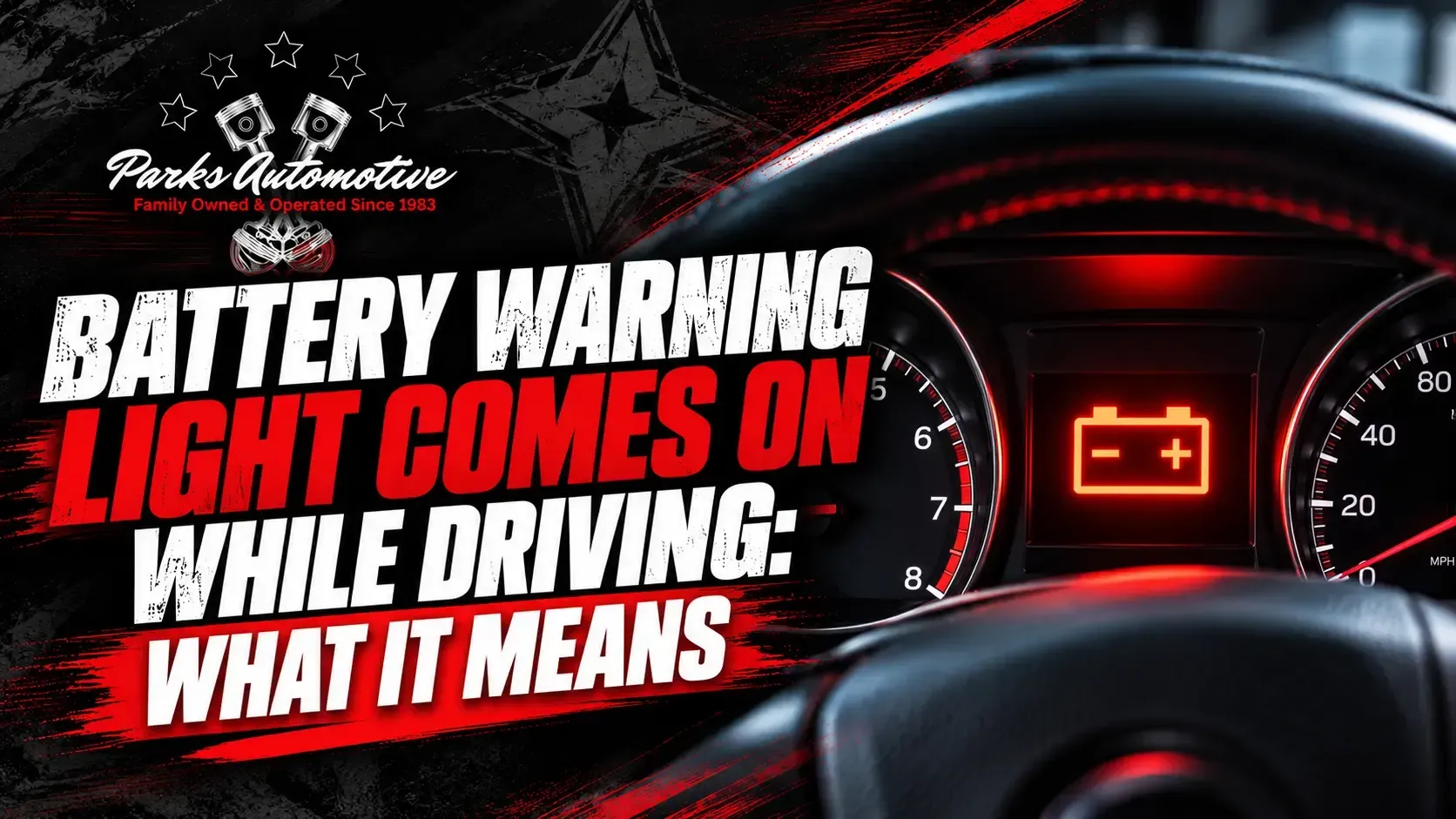
Battery Warning Light Comes On While Driving: What It Means
Discover More On:
A battery warning light while driving usually means the charging system is not maintaining needed voltage. Possible causes include the alternator, belt, wiring, grounds, battery, sensor, or charging controls.
At Parks Automotive, our
alternator testing and replacement process begins by checking alternator output under load. This helps identify whether the warning comes from the alternator or another part of the charging system.
A Battery Warning Light While Driving Means a Charging Fault
The battery icon monitors charging performance while the engine runs. If charging stops, the vehicle uses stored energy until the voltage becomes too low for essential systems.
Why the Light Does Not Automatically Mean the Battery Is Bad
A weak battery can contribute, but the light often appears because it is not being recharged. A new battery will not fix an alternator, belt, cable, or control fault. Our battery replacement service tests both systems first.
What to Do When the Battery Light Comes On
Treat the warning as a sign of limited power. The engine may keep running, but the remaining charge and shutdown order are unpredictable.
Reduce Electrical Load
Turn off heated seats, chargers, audio, and rear defrost. Keep headlights, hazards, wipers, and defogging on when safety requires them. Lower load may preserve power for a safe stop.
Find a Safe Place to Stop
Move out of traffic safely. Do not shut the engine off in an unsafe location because it may not restart. Once parked, arrange inspection or towing instead of continuing.
Watch the Temperature Gauge and Steering
Some vehicles use one belt for the alternator, water pump, and steering pump. A break may bring rising temperature or heavy steering with the light. Stop immediately if either appears.
Common Causes of a Battery Warning Light
A car battery light on while driving can come from several faults. The symbol does not identify the failed component.
Failing Alternator or Voltage Regulator
Alternator problems may cause intermittent output, dim lights, whining, or a warning that comes and goes. A regulator, internal part, or diode may fail. Output must be tested under load.
Slipping or Broken Serpentine Belt
A loose, glazed, or broken belt may stop the alternator from turning correctly. A weak tensioner or worn pulley can do the same. Our serpentine and drive belt service checks all three.
Loose, Corroded, or Damaged Connections
Terminals, alternator cables, grounds, and fusible links must carry current with low resistance. Corrosion, looseness, or heat damage causes voltage loss. Voltage-drop testing can find hidden resistance.
Weak Battery or Battery Sensor Fault
A damaged battery may not accept or hold a charge. An intelligent battery sensor may also report current, voltage, and temperature. Sensor or connection faults can alter charging commands.
Wiring, Module, or Smart-Charging Problem
Late-model vehicles vary alternator output using demand, battery state, and computer commands. Wiring, network, or battery-management faults can interrupt that strategy. Our auto electrical repair uses load, voltage-drop, and scan tests.
Other Symptoms That May Appear
Low voltage can affect several components together. Note every warning and behavior change as reserve power falls.
Dim Lights and Slow Accessories
Headlights may dim, the blower may slow, windows may drag, or screens may reset. Lights that brighten with engine speed suggest low output at idle.
Multiple Warning Lights or Electrical Shutdown
Falling voltage may trigger ABS, stability, transmission, or steering warnings. The engine can stall when the fuel pump, ignition, or control modules lose power.
Heavy Steering or Rising Engine Temperature
Heavy steering or rising temperature may indicate belt failure on mechanically driven systems. Vehicle layouts vary, but either symptom calls for an immediate stop.
Can You Keep Driving With the Battery Light On?
Do not keep driving with a charging system warning light. Remaining time depends on battery charge, load, and fault severity. Pull over and arrange a tow if it stays on, especially with dim lights, steering changes, rising temperature, or more warnings.
How We Diagnose a Charging System Warning
Diagnosis should identify the failed battery, alternator, belt drive, cable, sensor, or control. Missouri's auto repair guidance advises getting written costs and approval for charges beyond the estimate.
Test Battery Health and Alternator Output
We test battery condition separately from alternator output. Voltage and current are checked under load because output may fail only when demand rises.
Inspect Belts, Tensioners, Cables, and Grounds
We inspect the belt, tensioner, pulleys, terminals, cables, and grounds. Voltage-drop testing checks both sides for hidden resistance.
Check Smart-Charging Data and Control Circuits
On computer-controlled systems, we compare requested output with actual response and fault data. Wiring and sensor tests confirm the alternator command.
Cape Girardeau Conditions Can Expose Charging Problems
Missouri heat and cold weaken batteries and age belts, while humidity contributes to corrosion. Broadway and William Street traffic keeps alternator speed low while accessories run. I-55 and Route 74 may expose intermittent faults under load. Our Ford electrical and battery service covers alternator output, battery condition, grounds, and modules.
Takeaways
The battery icon while driving is usually a charging-system warning, not proof that the battery failed. Reduce nonessential electrical load, stop safely, and watch for dim lights, heavy steering, rising temperature, or multiple warnings. Testing should cover the battery, alternator, belt drive, cables, grounds, sensors, and charging controls. Replace only the component that test results confirm has failed.
Frequently Asked Questions
What does the battery warning light mean while driving?
The battery warning light means the charging system is not maintaining expected voltage while the engine runs. The alternator, belt, wiring, battery, sensor, or charging controls may be responsible.
Is the battery bad if the dashboard battery light comes on?
No, the warning light does not prove the battery is bad. The battery and alternator need separate tests because either one, or a connection between them, can cause the warning.
How long can a car run with the battery light on?
There is no reliable time estimate for how long the car will keep running. Remaining time depends on battery charge, electrical load, and the severity of the charging fault, so stop safely rather than testing the limit.
Can a loose belt cause the battery warning light?
Yes, a loose or slipping belt can reduce alternator speed and charging output. Belt condition, tensioner force, and pulley operation should be inspected together.
Should I replace the alternator as soon as the battery light appears?
No, test the charging system before replacing the alternator. A weak battery, belt problem, corroded cable, failed sensor, or control fault can create a similar warning.
Schedule Charging System Diagnosis in Cape Girardeau
For auto electrical repair in Cape Girardeau, contact Parks Automotive when the battery warning light remains on while driving. Call
(573) 335-2599 or visit
17 S Park Ave, Cape Girardeau, MO 63703 to schedule battery, alternator, belt, and circuit testing.

Bryant Parks
Bryant Parks is the owner of Parks Automotive LLC, a family-owned auto repair shop in Cape Girardeau, Missouri. He has worked full-time in the automotive trade since he was 16 and received his training at Nashville Auto Diesel College. In 2012, he took ownership of the shop his father, Joe Parks, founded in 1983.
Bryant and his daughter, Jessica Parks, lead a team that handles brake repair, engine diagnostics and repair, and suspension and steering repair. The shop services domestic, Asian, and European vehicles, including Ford, Chevrolet, Toyota, and Honda.
He traces drivability and electrical faults using a Snap-on Triton lab scope and a TOPDON Phoenix Max. These tools allow him to test sensors and circuits directly before recommending any part replacement.
More than four decades after his father opened the shop, Bryant continues to run it with the same approach. He explains what each vehicle needs in plain terms and treats every customer like family.
